Hey there.
Hope you had a good week. Today, we're talking YouTube.
What does aligning vectors have to do with YouTube strategy?
Back in 2017, I attended my first INBOUND conference while I was working for a national healthcare brand in Boston. I remember the energy in the room as I grabbed a prime spot for Dharmesh Shah's keynote, "Aligning Vectors: How to Scale a Business."
Dharmesh introduced an analogy that stuck with me: envisioning people in a company as vectors with magnitude and direction. To maximize impact, everyone needs to align their efforts towards the same goal.
For me, this idea resonated beyond just team dynamics. It laid out a blueprint for effective strategy. With a clear framework of policies and actions, alignment becomes the unlock for success, especially in content strategy on platforms like YouTube.
A few years later, I joined HubSpot and Dharmesh's talk continued to circulate in our hallways and Slack channels.
One misaligned piece can derail an otherwise promising strategy, making the difference between a growing channel and one that drains resources.
How do you drive predictable growth on YouTube?
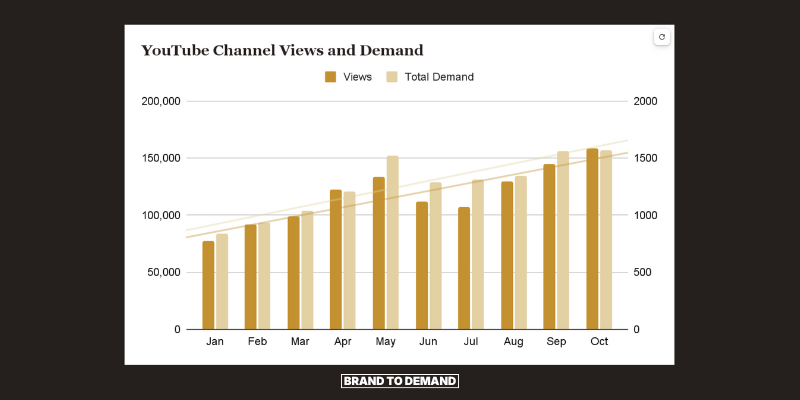
Earlier this year, I collaborated with Nelson Chacón Guzman, one of our top strategists, to re-launch a YouTube channel aimed at growing viewership and leads. Here's a snapshot of our progress:
Here's how we did it.
Why does every detail of a YouTube video matter?
No element of a video is too minor to perfect. A highly-produced video can still flop if its title and thumbnail aren't attention-grabbing. Similarly, a video with a strong average view duration (AVD) won't convert if it lacks a compelling offer.
Our approach is meticulous, and for good reason. When you're leveraging YouTube as a growth engine, every component must be engineered to align with your end goal. This focus not only drives discovery of the video but also results in meaningful leads.
Our Key Inputs:
- Product Use Case
- Topic Cluster
- Topical Keyword
- Audience Intent
- Video Angle
- Video Title
- Video Thumbnail
- On-Camera Talent
- In-Video Call to Action
- Description Copy
- The Offer
If any of these elements strays from the goal, the chain breaks.
What does an aligned YouTube video look like? A hypothetical example
Imagine you're the marketing lead for 18Birdies, an app that helps golfers improve their game. Lord knows I can use all the help I can get. You're investing in YouTube and need a new video to boost app downloads:
- Product Use Case: Use 18Birdies to improve your short game and reduce strokes within 125 yards.
- Topic Cluster: Wedge Play
- Keyword: "how to improve wedge play" (1,480 MSV)
- Audience Intent: Seek expert advice on hitting different shots around the green.
- Video Angle: Practical, pro-level tips in a Big Break-style chipping challenge.
- Video Title: "How to Improve Your Wedge Play Like a Pro"
- Video Thumbnail: A bold promise like "Drop 5 Strokes with Wedge Play"
- On-Camera Talent: Partner with a charismatic teaching pro who can simplify complex tips.
- In-Video Call to Action: Subtly around the 2-min mark: "Want a free AI swing analysis? Try 18Birdies."
- Description Copy: "Get a Free AI Swing Analysis to Improve Your Game"
- The Offer: A free swing analysis that nudges users to download the app.
By aligning every input, from the topic to the in-video CTA, we create content that not only educates and entertains, but also converts.
Why does this approach work?
The beauty of this method is its versatility. Whether it's YouTube, blog posts, podcasts, or webinars, alignment is the unlock. When all vectors point in the same direction, their collective performance is linear. That's why marketers have to continue working on their craft.
Dharmesh's 2017 talk was about team alignment, but it evolved into a guiding principle for content strategy. Align the vectors, and growth becomes achievable.
Until next week ✌️
Kyle
P.S. Big shoutout to Nelson and Carl Mueller who are building an incredible YouTube Network at HubSpot. I learn from you guys every day.